Mushrooms & Microdosing
Microdosing Psilocybin: What It Is, Why People Do It, and How to Approach It Mindfully
Jun
A few years ago, microdosing was mostly something people discussed in hushed tones at tech conferences or on niche Reddit forums. Now it’s in mainstream wellness conversations, podcasts, and newspaper features. The interest is real, but so is the confusion around what it actually involves, what the research says, and what the legal picture looks like in Canada.
This guide takes a straightforward look at it all. Not to push you toward anything, but because people exploring this topic deserve accurate information rather than hype.
What Is Microdosing, Exactly?
What is microdosing in plain terms? It’s the practice of taking a very small, sub-perceptible dose of a psychedelic substance on a regular schedule. The keyword is sub-perceptible, meaning you’re not supposed to feel high, altered, or dissociated from reality in any noticeable way. You go about your day. You work, cook dinner, and have a normal conversation. The dose is quiet enough to stay in the background.
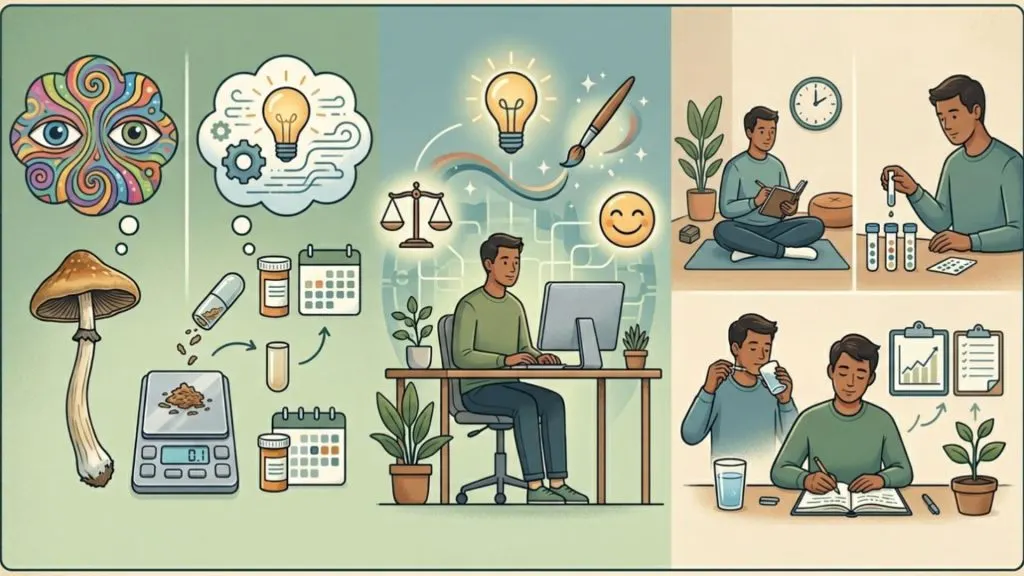
What is microdosing specifically in the context of psilocybin? It means taking a fraction of what would constitute a full psychedelic dose of magic mushrooms. Where a full experience might involve 1 to 3 grams of dried fungi (enough to produce significant visual and mental changes), a microdose is roughly 0.1 to 0.3 grams. About one-tenth of a full dose, sometimes less.
At that amount, the experience is subtle almost by design. Some people describe it as feeling like a good cup of tea rather than a cup of coffee – a slight lift, a bit more alertness, nothing dramatic. If you’re noticing strong effects, the dose was too high. A proper microdose stays invisible enough that you’d almost wonder if anything happened at all.
How a Microdose Differs From a Full Dose
The numbers make the distinction clear. A full psychedelic dose of dried mushrooms (one to three grams) produces significant effects. Colors shift. Walls can seem to breathe. Thoughts move in unexpected directions. Emotions surface. It’s a full experience that demands a safe space, free time, and a lot of intention.
Microdosing mushrooms sits at a completely different point on that spectrum. At 0.1 to 0.3 grams, there are no visual changes, no loss of clarity, and no disconnection from your environment. The idea is to capture whatever subtle neurological effect the compound might have without crossing into the territory of altered states.
The practical difference is this: someone on a full dose needs to clear their schedule. Someone microdosing mushrooms is, theoretically, able to function normally, and that functional aspect is a big part of why it appeals to so many people, particularly those in high-focus professional environments.
Why People Microdose: Reported Reasons
Most of what we know about why people try this comes from self-reported accounts – personal experiences shared online, in community forums, between friends. These are anecdotal, not clinical outcomes. Worth remembering as you read through the list.
That said, the patterns in what people report are consistent enough to warrant attention. The most frequently mentioned motivations:
- A mood lift during the regular workday – feeling slightly more at ease, less reactive to small frustrations.
- More focus, particularly on tasks that usually require sustained concentration.
- Enhanced creativity, which is why the practice has found a strong following among writers, designers, and musicians.
- And reduced day-to-day stress – a general sense of being less rattled by things that would normally wear you down.
The microdosing benefits people describe online sound appealing. But there’s an important caveat: what works clearly for one person does nothing for another. The microdosing mushrooms benefits being discussed on the internet are personal experiences, not medical guarantees. Treating them as hard evidence of what you’ll feel would be a mistake.
What the Research Actually Says
Here’s where things get genuinely honest. The science is early, incomplete, and in some areas contradictory. We don’t have a solid body of research to back up the claims circulating online, at least not yet.
Some studies have shown statistically positive results. Others show mixed results or are no better than a placebo. And that last word matters: in several trials comparing real psilocybin against a dummy pill, both groups reported feeling significantly better. That’s a meaningful finding. It suggests the power of expectation is substantial here, and that some of the benefits of microdosing mushrooms people report may reflect the placebo effect as much as the compound itself.
None of this means the practice is worthless or that people’s experiences aren’t real to them. It means the science hasn’t caught up to the public trend yet, and honest conversation about microdosing requires acknowledging that gap rather than glossing over it.
Microdosing for Depression and Anxiety: A Cautious Look
This is the area where the most caution is warranted. Microdosing for depression and anxiety has become a heavily discussed topic in wellness communities, and the anecdotal accounts that circulate can sound genuinely compelling. People share stories of lifted moods, reduced anxiety, and a renewed sense of perspective.
But psilocybin, at any dose, is not a licensed or approved treatment for depression or anxiety in Canada. It is not a substitute for professional mental health support. If you’re struggling, the most important thing you can do is talk to a doctor or therapist who can offer proven, legal treatment options tailored to your actual situation. Self-treating with an unregulated substance while deferring or avoiding professional help is a genuine risk, not because psilocybin is dangerous in every context, but because delaying appropriate care can have real consequences.
If you’re curious about psilocybin’s therapeutic potential, there is research worth reading, but it involves supervised clinical settings with professional oversight. Not home self-administration.
How to Approach It Mindfully (and Safely)
If you’re going to explore microdose mushrooms, a harm-reduction approach is the baseline.
Start with your intention. What are you trying to understand or achieve? Clarity about the goal helps you track whether anything is actually shifting, and keeps the practice grounded rather than turning into something you’re just doing out of curiosity or social pressure.
Journaling is one of the most consistently recommended tools in this space. Tracking your mood, sleep, energy, and focus in a simple daily log gives you concrete data to work from rather than relying on vague impressions. It’s also how you notice if something isn’t working, or if something is going wrong.
On scheduling: people don’t typically dose every day. A common protocol is one day on, two days off. This prevents tolerance from building and gives the nervous system time to recover between doses.
Know the contraindications. A family or personal history of psychosis, schizophrenia, or severe bipolar disorder is a clear reason to avoid psilocybin entirely (at any dose). The same applies to pregnancy and certain cardiac conditions. This isn’t overcaution. These risks are documented.
Browse our magic mushroom section for currently available products if you’re looking to understand what’s out there.
Microdosing in Canada: What to Know First
The legal picture here is clear and leaves little room for interpretation. Psilocybin is a Schedule III controlled substance under the Controlled Drugs and Substances Act. Growing it, selling it, and possessing it are all illegal under federal law.
If you search for microdose mushrooms Canada options online, you’ll find no shortage of sites claiming to ship products discreetly across the country. You might even find physical storefronts in cities like Vancouver or Toronto operating with surprising visibility. Their existence doesn’t mean they’re operating legally – most function in an unregulated grey area, or simply break the law and operate until enforcement catches up with them.
Microdose mushrooms Canada sources that are genuine about what they are will tell you this directly. Health Canada has created limited exemptions for specific medical and end-of-life cases, but these require a formal application process; they’re not accessible through a dispensary or an online order.
Microdosing shrooms in Canada means operating outside the formal legal framework. That’s the reality. The risk of criminal consequence is real, even if enforcement is inconsistent. Understanding that before you make any decisions is important, because you deserve to know what you’re actually dealing with.
Looking to explore psilocybin products? Browse our magic microdose mushrooms mushroom selection for clearly labeled options across different formats and potencies. Same-day delivery across Hamilton, Burlington, and Brantford on orders over $100. Contact us for a recommendation before you order.
Disclaimer: This article is intended for educational and harm-reduction purposes only. Psilocybin is a Schedule III controlled substance under Canadian federal law. Possession, sale, and production are illegal outside of Health Canada-approved programs. Nothing in this article constitutes medical or legal advice. If you are considering psilocybin for mental health purposes, please consult a licensed healthcare professional. Do not use psilocybin as a substitute for professional medical treatment.
